Concepts
The mental model for Meerkat Cloud. Once these five pieces click, the rest of the docs are examples.
Monitor
A monitor is the unit you create. It holds:
- a plain-English
description(what “meaningful change” means) input_params(usually aurlor tracking link)- schedule:
one_offorrecurring+frequency output_webhook— where to POST results
Create monitors with client.monitors.create
(Ruby gem)
or the Cloud dashboard —
same API operations either way. All monitors are recurring (no task_type).
Run
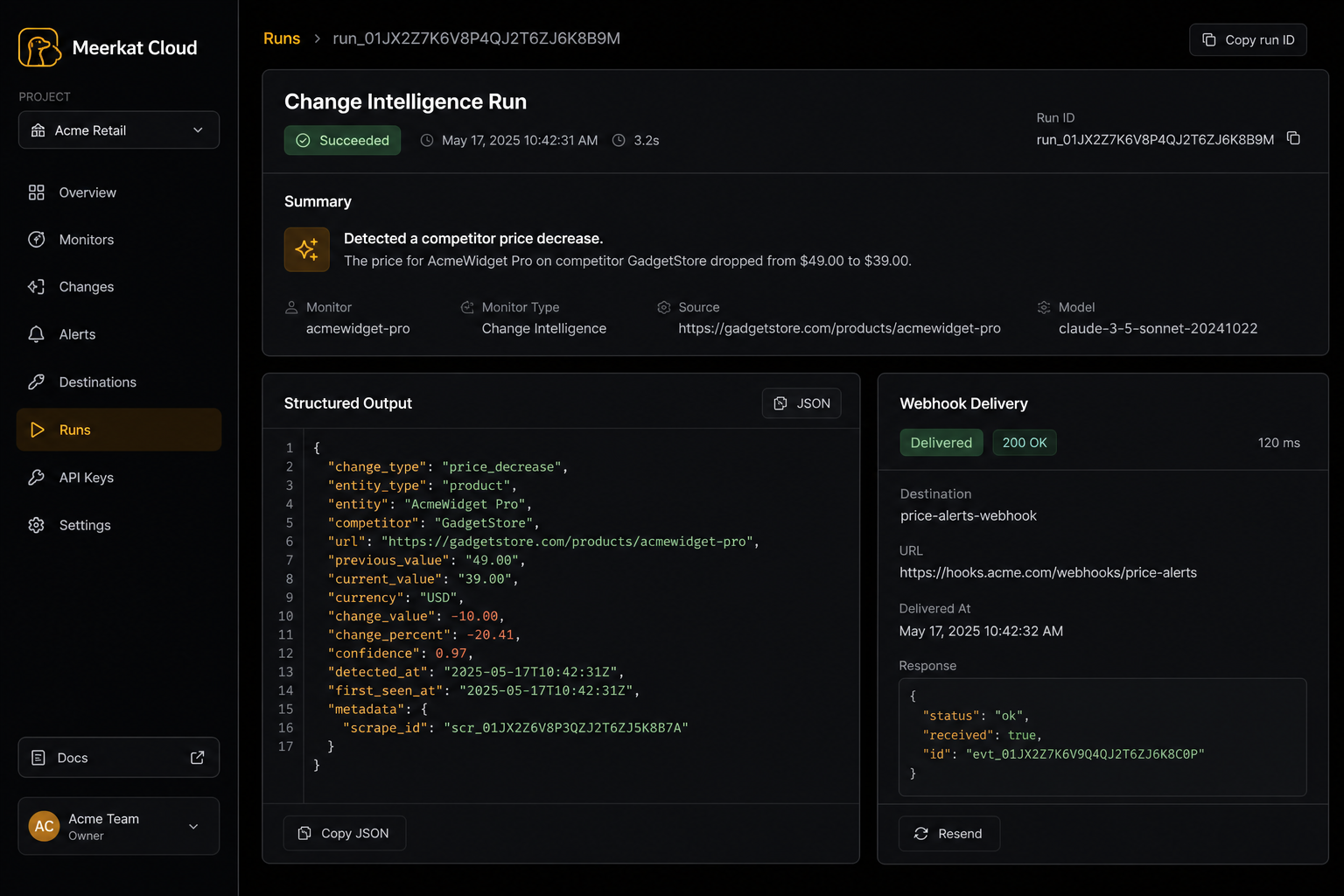
A run is one execution of a monitor. Each run has a status
(pending, running, succeeded, failed),
structured findings, and webhook delivery history.
Inspect runs in the Cloud dashboard — useful while you validate instructions and webhook handlers.
Webhook
Meerkat delivers results with an HTTPS POST to your app. Payloads are HMAC-signed — verify them in Rails with the gem helper.
class Webhooks::MeerkatController < ApplicationController
  include Meerkat::Rails::WebhookVerification

  def create
    payload = JSON.parse(request.raw_post)
    # payload["data"] includes summary / structured findings
    head :ok
  end
endBYOK (bring your own LLM key)
Change Intelligence needs a model to understand pages. You attach your Anthropic or OpenAI key in the account menu → LLM key. Meerkat never resells tokens.
Credits & pricing
Free trial: 1 monitor and 1 run. After that, buy $20 — 5 tasks, 50 runs. Optional auto top-up recharges when run credits hit zero.
Meerkat::SubscriptionRequiredError in the gem) with a link to billing.